Comprehensive dental services

Nothing is more important to us than your health and wellbeing. From general checkups to dental implants, smile makeovers, and emergency care — it's all done here.

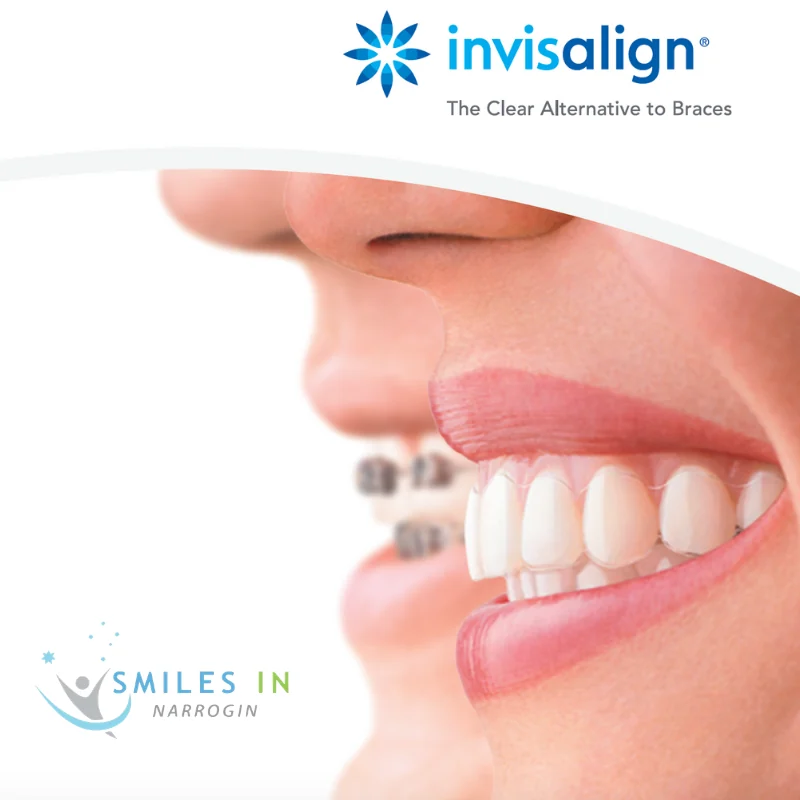
Invisalign — the clear alternative to braces, available at Smiles in Narrogin
Invisalign provider

A clear alternative to braces

Sequential clear aligners that move your teeth millimetre by millimetre until they're straight. For adults, teenagers, and complex cases — with an honest assessment of whether Invisalign is right for you.

  • For adults and teenagers — not just kids
  • Removable for eating, brushing and flossing
  • High success rate, even on complex cases
  • Complimentary consultation, no obligation
Book a consultation
01 / General care

Everyday dentistry

Checkups, fillings, gum care and emergencies — the routine and not-so-routine work that keeps your mouth healthy for life.
Dental cleaning

Professional cleaning — a "scale and clean" — is one of the most neglected aspects of dental health, and one of the most important to keep your teeth firmly in place.

Regular removal of plaque and calculus prevents gingivitis and periodontal disease, both of which cause slow, progressive bone loss around the teeth. Enough bone loss and teeth become wobbly, painful, and eventually need to come out.

The procedure is gentle — electronic and manual instruments carefully remove the plaque and calculus you can't get to with even the most meticulous brushing and flossing.
Dental fillings

Fillings are needed when you have decay, broken or worn old fillings, or fractured teeth. We use a range of materials, but the most common is white dental composite.

Traditional amalgam (metal) fillings aren't used as much now, due to historical concerns. Composite is a great solution for most cases, and for more broken-down teeth we have ceramic alternatives.

We can often avoid more invasive treatments like dental crowns — but the dentist needs to see you first to confirm a ceramic filling is the better option.
Toothache & emergency dental treatment

No one likes being in pain. Anaesthetic works less effectively when an active toothache is present — severe inflammation gets in the way — so the best strategy is preventive care.

That said, when you do have a toothache, don't hesitate to call us for a same-day appointment. We'll do everything we can to fit you in quickly and resolve the pain in the most efficient, pain-free way possible.
Tooth extractions

As dentists, we hate having to remove teeth — we know it can leave you worse off than when you came in. But when a tooth has a truly hopeless prognosis, we're left with no choice.

If we need to, have confidence we'll do it in the most painless, anxiety-free way possible. We're happy to facilitate treatment under mild sedation or sleep dentistry where appropriate.
Periodontal therapy

Needed when gum disease has progressed to the point that bone is being rapidly lost around the teeth — often in patients who smoke, have diabetes, or have an immune-affecting condition.

Local anaesthetic is often required as we need to get well under the gums. We chart pocket depths and use mechanical and chemical methods to reduce plaque and calculus and slow the bone loss.

Root canal treatment

Needed when decay reaches the pulp or nerve of a tooth, or when a tooth breaks and exposes the nerve. The best prevention is regular checkups with x-rays — caught early, root canal can often be avoided.

Once the root canal space is infected, we can't guarantee the tooth won't need treatment and a dental crown over the top to seal and protect it. After root canal, the tooth no longer has its protective nerve reflex, so a crown also stops it fracturing when you bite something hard.

The fee for root canal therapy varies with complexity, but is generally around $3,000 for a complex tooth.

02 / Restoration

Replace what's missing

Implants, crowns, dentures and bridges — proven options to restore function, comfort and the way your smile looks.

Dental implants

The best option for single-tooth replacement, second to none. They fit, function and look like real teeth — and because they're titanium, they're as strong as natural teeth or stronger.

Titanium has a unique biological property: it bonds to bone and integrates into the jaw. That makes implants the most biologically compatible tooth replacement we have. The downside is cost.

Think of dental implants more like a small-scale hip replacement than a filling — careful diagnosis, planning, surgery and precision fitting over a number of months. With proper care they can last a lifetime, but they need ongoing maintenance, just like natural teeth.

Not everyone is suitable. You need a careful, thorough assessment from a practitioner experienced in placing implants before we know whether you're a candidate.

Dental crowns

The most misunderstood treatment in dentistry. People often baulk at the cost — $1,500 to $3,000 per crown — but with good care, crowns can last 30+ years. Spread over their lifetime, the cost is more reasonable than it first appears.

Front teeth need careful shade matching and design, with multiple try-ins. Sometimes we need more expensive materials like gold for strength in hard-to-see back areas. Most simple crowns sit around $1,500 because of the chair time plus the off-site lab technician who designs and fabricates them with jeweller-level precision.

Dentures

A good, cheaper solution for missing teeth. With advanced technology and training, implant-retained dentures are the best option for both function and comfort.

If implants aren't an option for you, basic dentures are available — we'll walk you through every alternative honestly so you can make an informed choice.

Dental bridges

Not used as commonly as they were. When you're missing a single tooth between two other natural — or preferably heavily filled — teeth, we can use a bridge to fill the gap.

Probably not as good as an implant for a single missing tooth (we have to drill into two teeth to replace one), but when multiple teeth are missing and implant surgery isn't suitable, bridges are still a strong option with a long track record.

03 / Cosmetic

Improve your smile

Whitening, veneers, makeovers, alignment — finished to the highest standard with an honest take on what will actually work for you.

Teeth whitening

One of the most sought-after treatments in dentistry — but it doesn't always work. There are several reasons not everyone is suitable, and we have more than one method to improve the shade of your teeth.

Don't trust the gimmicky advertising you see online and on TV. Come in for a professional consultation so we can talk through what's actually going to work for you.

Porcelain veneers

A long-term, very successful way to improve the shade and shape of your teeth and give you an amazing smile. Veneers and crowns can correct mild-to-moderate shape and shade issues.

For more irregular or really dark teeth, we may need to combine crowns with orthodontics for a stable long-term result. Not everyone is suitable, and even if you are, there are maintenance details to discuss.

Call us today to book a consultation and we'll talk you through it properly.

Smile makeovers

Your smile is the first thing people notice after your eyes — it's not vain or excessive to consider improving it.

We can do a thorough smile analysis and determine the best solution. Materials have improved enough that porcelain veneers and crowns aren't the only option anymore — we've had good long-term results with dental composites too.

If you're an existing patient, call us to book a complimentary consultation to discuss your options.

Orthodontics — clear aligners, braces, Invisalign

Teeth straightening isn't just for children anymore. More and more adults are using Invisalign — sequential clear aligners that move your teeth millimetre by millimetre until they're straight.

Not everyone is suitable, but with proper up-front diagnosis and a good treatment plan, we have a high success rate even for complex cases.

04 / Surgery

Surgery & sedation

When the work is more involved — done properly, with the right team and the right level of sedation for the procedure.

Oral surgery & wisdom teeth removal

Sometimes surgery is needed. When teeth are too broken down to grip with forceps, we need to do a surgical extraction including the roots. Wisdom teeth often require removal of bone and separating the tooth into pieces to take it out less traumatically.

We assess first — if the tooth can't be easily removed straight away, we'll schedule oral surgery just as you would at a medical hospital. We'll also discuss whether sedation is appropriate. Mild tablet sedation is most common, but sleep dentistry is sometimes needed.

Sleep dentistry

Sounds great — have all your treatment done while you sleep. Just understand the trade-offs: a specialist needs to monitor you, which adds cost.

Sleep dentistry puts you into a deep state of unconsciousness — not so deep you lose your breathing reflex, but deep enough that you're unaware of what's happening. Under specialist care it's very safe, and it's now common for invasive or uncomfortable procedures like wisdom teeth removal and implant surgery.

We also use sedation for patients with extreme dental fear, often from bad past experiences. Ask about milder options too — sedation tablets can help if you just need to take the edge off.

For everyone

Dental care for the whole family

We look after patients from all walks of life and all ages. Good oral health care habits need to be instilled at a young age and continued throughout life.

That means adult care, child care, and orthodontic care under one roof — with a team that takes time to make every patient feel comfortable, no matter their age or history with dentistry.

Book appointment

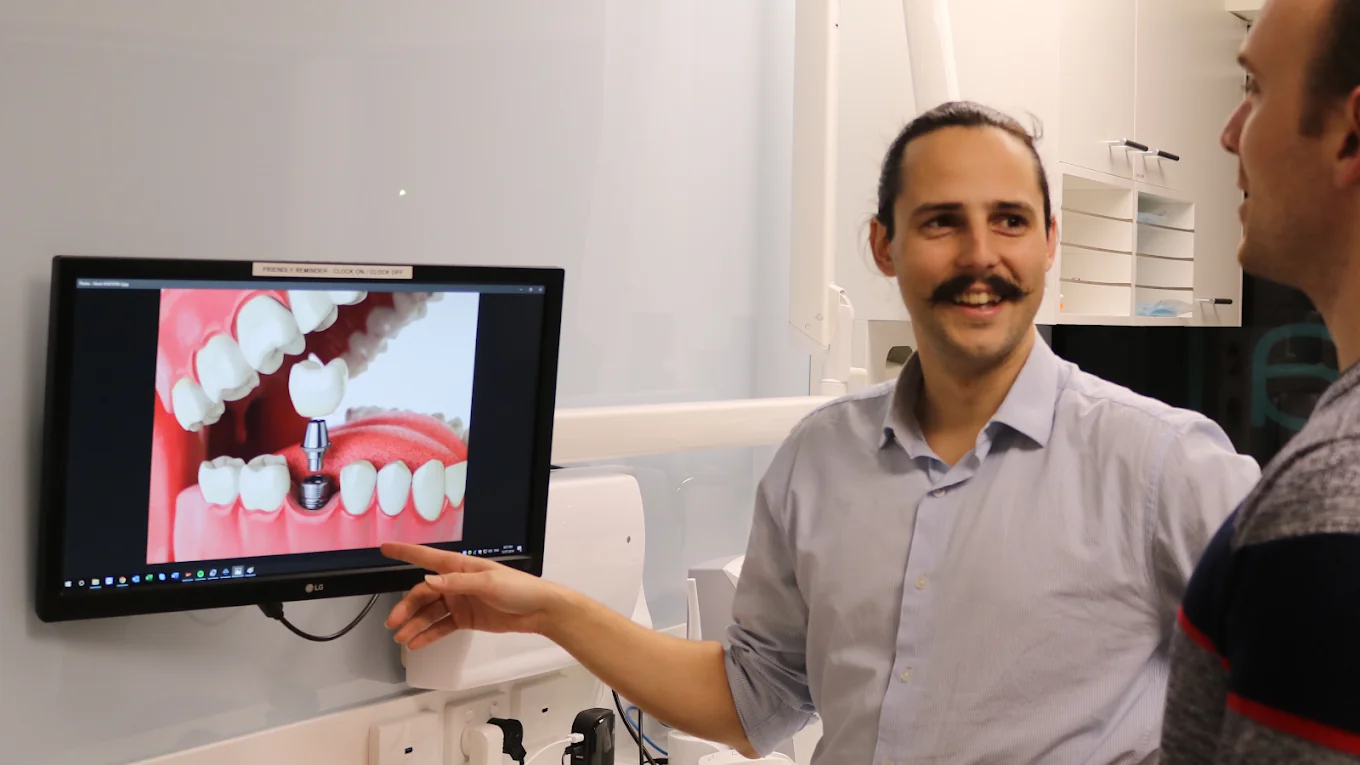
Dr Ryan Moldrich discussing treatment options with a patient